
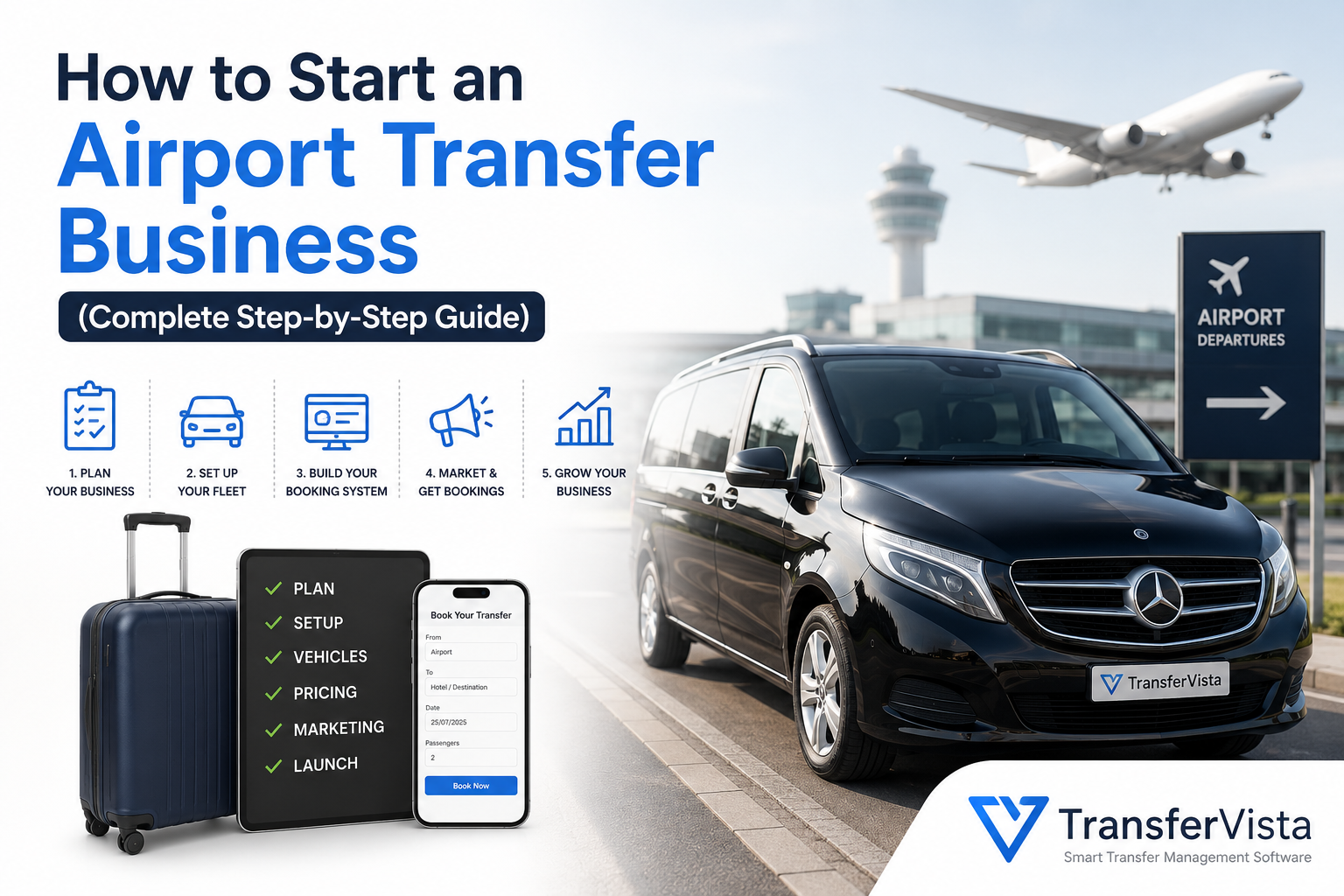

Starting an airport transfer business is an attractive entrepreneurial opportunity. Airlines move over 4 billion passengers annually, and every single one needs transportation from the airport to their destination.
Unlike many business ideas, airport transfers have several built-in advantages:
- Recurring demand – Flights arrive 24/7, 365 days a year
- Premium pricing – Customers value reliability and will pay for it
- Relationship-building – Corporate clients book regularly
- Low barrier to entry – You can start with one vehicle
- Évolutivité – Once you nail the model, it scales
But starting successfully requires more than just buying a vehicle and waiting for customers. You need the right legal setup, proper insurance, the right technology, professional drivers, and a solid marketing strategy.
In this complete guide, we’ll walk through every step of starting an airport transfer business—from market research to scaling to multiple locations.
Step 1: Research Your Airport Transfer Market
Before investing a single dollar, understand your market deeply.
Understand Airport Traffic Patterns
Visit your target airport and observe:
- Peak arrival times – When do most passengers arrive? (Typically early morning and early evening)
- Peak departure times – When are passengers heading to the airport? (Same peaks)
- Seasonal variation – Summer is busier than winter for most U.S. airports
- Average wait times – How long do passengers wait for transportation?
- Current competition – What transportation options exist?
Most commercial airports handle 10,000-50,000+ passengers daily. Even capturing 0.1% means dozens of daily bookings.
Analyze the Competition
Research existing airport transfer services:
- Happy Shuttle, USA Transfers, Go Airport Shuttle – Major chains (high visibility but high overhead)
- Local independent operators – Small companies with limited service areas
- Rideshare (Uber, Lyft) – Growing presence but surge pricing and variability
- Hotel shuttles – Limited to hotel guests
- Rental cars – Expensive for single passengers
Key insights to find:
- What gaps exist in the market?
- Are competitors satisfied customers or struggling?
- Is there demand for premium service?
- What areas are underserved?
Calculate Realistic Demand
Conservative estimate: A mid-sized airport serves 20,000+ daily passengers. If you capture just:
- 0.1% = 20 passengers/day = 600/month = 7,200/year
- 0.5% = 100 passengers/day = 3,000/month = 36,000/year
- 1% = 200 passengers/day = 6,000/month = 72,000/year
At $40-60 per transfer, even 0.5% market capture means $120K-180K annual revenue from a single vehicle.
Identify Your Target Market
Airport transfers serve several customer segments:
- Business travelers – Want reliability, predictability, professionalism
- Leisure tourists – Want friendly service, local knowledge
- Families – Need luggage space, safety assurances
- Senior travelers – Appreciate assistance, accessibility features
- International visitors – May not speak English, need patience
- Corporate accounts – Book regularly for employees
Pick 1-2 target segments to focus on initially. This shapes your marketing and service positioning.
Step 2: Create a Detailed Business Plan
Your business plan is your roadmap and also required for financing.
Executive Summary
One-page overview of:
- What your business is (airport transfer service)
- Why it will succeed (market opportunity, competitive advantage)
- Financial projections (first 3 years)
- Funding needs
Market Analysis
- Airport passenger volume (research online or call the airport)
- Current competition and their limitations
- Target customer segments
- Pricing analysis (what do competitors charge?)
- Growth potential
Service Offerings
Define what you’ll offer:
- Standard service – Sedan for 1-3 passengers, basic experience
- Premium service – Luxury vehicles, white-glove service, higher price
- Group transfers – Van/shuttle for 6+ passengers
- Corporate contracts – Dedicated service for regular business clients
- Specialty services – Wheelchair accessible, pet-friendly, etc.
Financial Projections
Create 3-year projections showing:
Year 1 – Startup Phase:
- Vehicle purchase: $25,000-40,000 (or lease: $600-1,200/month)
- Insurance, licensing, permits: $3,000-5,000
- Marketing and website: $2,000-5,000
- Technology/software: $3,600/year ($300/month)
- Operating costs (fuel, maintenance): $4,000-6,000/month
- Driver costs: $0 (if you drive) or $2,000-3,000/month (if hired)
- Target revenue: $60,000-80,000
- Year 1 goal: Break even or modest profit
Year 2 – Growth Phase:
- Add 2-3 more vehicles
- Hire dedicated drivers
- Expand to corporate clients
- Target revenue: $200,000-300,000
- Goal: 15-20% profit margin
Year 3 – Scale Phase:
- 5-8 vehicles
- Professional management team
- Multiple revenue streams
- Target revenue: $400,000-600,000
- Goal: 20-25% profit margin
Competitive Advantage
What makes YOUR service different?
- Premium vehicles and well-trained drivers?
- Dedicated service to a specific customer segment?
- Technology-enabled (app booking, real-time tracking)?
- Focus on a specific airport not well-served by competitors?
- Corporate partnerships?
Step 3: Obtain Required Licenses & Permits
This varies by location, but typically includes:
Business License
- Contact your local city/county business licensing office
- Cost: $50-500 depending on location
- Timeline: 1-2 weeks
- Allows you to legally operate a business
Transportation Operating Permit
This is location-dependent but critical:
- Some states/cities require a PUC (Public Utilities Commission) permit – Required if you transport passengers for hire
- Some areas require a ground transportation license – Specific to airport services
- Some areas require nothing – Depends on local regulations
Research requirement: Call your state PUC or local airport authority and ask: “What permit do I need to operate an airport transfer service?”
- Cost: $0-2,000 depending on location
- Timeline: 2-12 weeks (some require public hearings)
- Documentation needed: Business plan, insurance, vehicle registration
Airport Authority Authorization
Many airports require ground transportation operators to be registered:
- Contact your airport’s ground transportation office
- Provide proof of insurance and permits
- Some airports charge annual fees ($100-1,000)
- Some airports require background checks for drivers
Step 4: Secure Proper Insurance Coverage
Insurance is non-negotiable and often required by airports/permits.
Commercial Auto Insurance
- Liability coverage (typically $1M minimum) – Covers injuries/property damage
- Passenger coverage – Specific to transporting passengers
- Cost: $2,000-4,000/year per vehicle
- Must get quotes from commercial insurers (personal insurance doesn’t cover commercial use)
General Liability Insurance
- Covers injuries at pickup/dropoff locations
- Cost: $500-1,000/year
Workers Compensation Insurance
- Required once you hire drivers
- Cost: 20-30% of driver payroll
Insurance Tips
- Shop multiple quotes – rates vary significantly
- Look for transportation-specific insurers (they understand airport operations)
- Ask about multi-vehicle discounts
- Get everything in writing before buying vehicles
Budget: $3,000-5,000/year for insurance on your first vehicle
Step 5: Implement Booking & Dispatch Software
This is your operational backbone. This is where TransferVista comes in.
Without software, you’re managing everything manually:
- Customer calls for bookings → You write it down
- Drivers call for assignments → You check your paper schedule
- Customers track their ride → They can’t (you have no visibility)
- Billing is manual → Errors and delays
- No data on performance → Can’t optimize
Good airport transfer software automates all this.
Why Software is Critical for Airport Transfers
Airport operations have unique requirements generic taxi dispatch software doesn’t handle:
- Flight Integration – When a flight lands, automatically assign drivers without customer calling
- Real-time Tracking – Customers see their driver’s location, drivers know where to go
- Airport Compliance – Automatically track driver backgrounds, licenses, ADA compliance
- Customer Communication – Automatic SMS/email updates when flights change
- Pricing & Billing – Fixed rates, corporate billing, payment processing
- Driver Management – Background checks, performance ratings, compliance docs
- Analytics – Track profitability, driver performance, customer satisfaction
Why TransferVista
TransferVista is purpose-built for airport transfer operators:
- Airport Flight Integration – Monitors real-time flights, auto-assigns drivers when flights land
- Professional Driver App – Drivers see assignment, pickup details, route, GPS navigation
- Customer Portal – Customers track their ride in real-time, know driver details
- Booking Options – Website, mobile app, phone booking all integrated
- Payment Processing – Card, cash, corporate billing all handled
- Compliance Automation – Tracks driver backgrounds, licenses, ADA compliance automatically
- Analytics Dashboard – Revenue, costs, driver performance, customer satisfaction
- 24/7 Dedicated Support – Real people, not chatbots, understands airport operations
- Quick Setup – Operational in 1 week with dedicated implementation support
Getting Started with Software
Start with TransferVista:
- Try free for 1 month – See how it works, test with your first drivers
- Schedule a demo – Talk to someone who understands airport operations
- Basic setup – Create your service areas, set pricing, configure airports
- Driver setup – Add drivers, give them the app, they’re ready to work
- Go live – Start taking bookings through the platform
Cost: Starting at $299/month, but unlimited bookings and drivers (no per-ride fees that eat into margins)
Step 6: Purchase or Lease Vehicles
Vehicle choice impacts your positioning and profitability.
New vs. Used Vehicles
New Vehicle:
- Pros: Reliability, warranty, professional appearance
- Cons: High upfront cost ($35,000-55,000)
- Best for: Premium service positioning
Used Vehicle (3-5 years):
- Pros: Lower cost ($15,000-25,000), still reliable
- Cons: Warranty issues, potential maintenance costs
- Best for: Budget-conscious startup
Vehicle Types
Sedans (Toyota Camry, Honda Accord, Nissan Altima):
- Cost: $25,000-35,000 new, $12,000-18,000 used
- Capacity: 3-4 passengers + luggage
- Best for: Individual/couple travelers
SUVs (Toyota Highlander, Honda Pilot):
- Cost: $30,000-45,000 new, $15,000-25,000 used
- Capacity: 5-7 passengers + luggage
- Best for: Families, groups, premium positioning
Vans (Sprinter, Transit):
- Cost: $40,000-60,000 new, $20,000-35,000 used
- Capacity: 8-14 passengers
- Best for: Shuttle services, group transfers
Buy vs. Lease
Buy:
- Pros: Ownership, builds equity, no mileage restrictions
- Cons: High upfront cost, maintenance responsibility
- Good for: Long-term commitment to business
Lease:
- Pros: Lower monthly payment ($600-1,200/month), maintenance included, new vehicle
- Cons: Mileage restrictions (typical 12,000-15,000/month), no equity built
- Good for: Testing the business model without huge investment
Branding Your Vehicle
Airport transfers are a premium service. Your vehicle appearance matters:
- Professional paint/wrap with business name and logo ($1,000-3,000 optional)
- Clean, well-maintained interior (critical)
- Professional appearance (dark tinted windows, premium wheels optional)
- Business signage (improves recognition and credibility)
Step 7: Hire & Train Professional Drivers
Your drivers ARE your brand.
Driver Requirements
Look for drivers who have:
- Clean driving record – No accidents/violations in past 3-5 years
- Experience with passenger transport – Taxi, rideshare, shuttle background preferred
- Customer service orientation – Friendly, professional, problem-solving
- Local knowledge – Knowing the area is a huge plus
- Reliability – Shows up on time, maintains vehicle, communicates
- Professional appearance – Neat, clean, professional
- Valid commercial driver’s license (depending on vehicle size)
Background Checks
Required for airport operations:
- Criminal background check
- Driving record check
- Sex offender registry check
Cost: $50-150 per driver
Timeline: 1-2 weeks
Driver Training Program
Before drivers work with customers:
- Vehicle orientation – How to use equipment, passenger comfort features
- Route knowledge – Major routes, airport terminals, pickup/dropoff locations
- Customer service standards – Your expectations for professionalism
- Technology training – How to use the dispatch app, GPS, communication
- Safety protocols – Emergency procedures, handling difficult situations
- Accessibility basics – How to assist elderly/disabled passengers
Driver Compensation
Options:
- Per-trip commission (40-50% of fare) – Driver earns more when busy
- Hourly rate ($15-20/hour) – Predictable income, less motivation risk
- Hybrid (hourly + commission) – Balances stability and incentive
Recommendation for startup: Commission-based initially (you only pay when you earn), then shift to hourly once you have consistent volume.
Step 8: Build Website & Online Presence
Your website is your 24/7 sales person.
Essential Website Elements
- Homepage – Clear value proposition, service overview, call-to-action
- Booking page – Quick online booking (integrate with your software)
- Tarification – Clear, transparent rates by route
- Service areas – Which airports/areas you serve
- About us – Your story, why customers should choose you
- Reviews/testimonials – Social proof (start collecting immediately)
- Contact – Phone, email, contact form
- Mobile responsive – Must work on phones (most bookings come from mobile)
Intégration de la réservation en ligne
Your website’s booking form should connect to your software:
- Customer enters pickup/dropoff, date, time
- System shows pricing and availability
- Customer pays online or books
- Booking automatically enters your dispatch system
- Driver is assigned and notified
- Customer gets confirmation and tracking link
Profil d'entreprise Google
Critical for local visibility:
- Create a Google Business account for your business
- Optimize profile: photos, hours, service areas, description
- Ask customers to leave reviews (critical for rankings)
- Post regular updates (new vehicles, seasonal offers, etc.)
This is how customers find you when searching “airport transfer near me.”
Step 9: Market Your Airport Transfer Service
You have the service—now get customers.
Direct B2B Partnerships
Most profitable customers are businesses that book regularly:
Corporate accounts:
- Contact local businesses, law firms, healthcare providers
- Offer corporate rates (10-20% discount for regular volume)
- Provide monthly invoicing and reporting
- Assign dedicated drivers for consistency
Hotel partnerships:
- Contact hotel concierge departments
- Offer commission or preferred rates for referrals
- Position as premium alternative to hotel shuttle
- Provide phone/email for quick bookings
Travel agencies:
- Partner with local travel agencies
- Offer commission on referred bookings
- Provide instant online booking
Airport partnerships:
- Some airports run “ground transportation” pages with vendor listings
- List your service
- Improves visibility for arriving passengers
Digital Marketing
Google Ads (Paid Search):
- Bid on keywords like “airport transfer [city]”, “airport shuttle”, etc.
- High intent traffic (people actively searching)
- Budget: $300-500/month initially
- Expected ROI: Often 3-5x
Facebook/Instagram:
- Target ads to people arriving in your airport (geo-targeted)
- Showcase your vehicles and service
- Budget: $200-300/month
- Build social proof with customer testimonials
Google Business Profile (Local SEO):
- Free listing that shows up in local searches
- High-value traffic from customers searching “airport transfer near me”
- Collect reviews (critical for ranking)
Word-of-Mouth
Your best marketing:
- Exceptional service generates referrals
- Ask customers to leave reviews
- Incentivize referrals (offer $10 discount for referrals that convert)
- Join local business networking groups
Ongoing Marketing Budget
First year:
- Website development: $2,000-5,000 (one-time)
- Google Business Profile: Free
- Google Ads: $300-500/month
- Social media: $200-300/month
- Total: $6,000-11,000/year
Step 10: Monitor, Scale & Optimize
Your first 6 months are about proving the model works.
Key Metrics to Track
- Revenu – Total bookings × average fare
- Utilization – % of time vehicle is actively transporting passengers
- Cost per booking – (Fuel + maintenance + vehicle cost) / bookings
- Customer satisfaction – Reviews, ratings, repeat booking rate
- Driver performance – On-time rate, customer ratings, incidents
Optimization Opportunities
First 90 days:
- Are you getting consistent bookings?
- Are customers satisfied? (Monitor reviews obsessively)
- What’s your actual profit margin?
- Which customer segments are most profitable?
Months 3-6:
- Can you add a second vehicle with current demand?
- Should you hire a driver or operate personally?
- Which marketing channels are working?
- Should you expand service areas?
Scaling
Once the model is proven:
3-6 months:
- Add 1-2 more vehicles
- Hire dedicated drivers
- Expand marketing to new customer segments
6-12 months:
- 5-10 vehicles
- Professional dispatch/operations management
- Corporate account focus
- Multi-airport expansion
Year 2:
- 15-25 vehicles
- Professional management team
- Multiple service tiers (budget, standard, premium)
- Multi-city operations
Common Mistakes to Avoid
Learn from others’ failures:
Mistake #1: Underestimating Startup Costs
Many entrepreneurs think: “I’ll buy a vehicle and start making money.”
Reality: Vehicle ($25K), insurance ($4K), permits ($2K), software ($3.6K), initial marketing ($3K) = $37.6K before earning first dollar.
Fix: Create realistic financial projections before starting.
Mistake #2: Skipping Professional Software
“I’ll just use spreadsheets and WhatsApp with drivers.”
Result: Chaos. Missed bookings, unhappy drivers, manual billing errors, no analytics.
Fix: Invest in software from day one (TransferVista starts at $299/month—far less than one missed booking).
Mistake #3: Poor Driver Training
Hiring drivers but not training them properly leads to:
- Customer complaints
- Negative reviews
- Lost repeat business
Fix: Invest 4-8 hours in thorough driver training before they take first passenger.
Mistake #4: Weak Marketing
“If I build it, customers will come.”
Result: Vehicle sits idle. Costs exceed revenue.
Fix: Budget 10-15% of expected revenue for marketing.
Mistake #5: Ignoring Compliance
Operating without proper permits/insurance leads to:
- Fines
- Lawsuits if accidents happen
- Business shutdown
Fix: Get all legal/insurance ducks in a row before day one.
Mistake #6: Not Focusing on Customer Experience
Airport transfers are a service business. Customer satisfaction is everything.
One bad review can cost hundreds of dollars in lost business.
Fix: Make exceptional customer experience your competitive advantage.
Financial Overview: Is This Profitable?
Startup Investment (1 vehicle):
- Vehicle: $25,000-35,000
- Insurance: $4,000/year
- Permits/licensing: $2,000
- Software: $3,600/year
- Website: $2,000
- Initial marketing: $3,000
- Total: $39,600-44,600
Monthly Operating Costs (1 vehicle):
- Insurance: $333/month
- Fuel & maintenance: $1,000/month
- Software: $300/month
- Marketing: $300/month
- Vehicle payment/lease: $600/month (if leased)
- Total: $2,533/month
Revenue Potential (1 vehicle):
- Average fare: $45
- Bookings per day: 4-6 (conservative)
- Bookings per month: 120-180
- Monthly revenue: $5,400-8,100
- Annual revenue: $64,800-97,200
Year 1 Profitability (1 vehicle, driving yourself):
- Annual revenue: $75,000 (average)
- Annual costs: $30,400 (excluding your labor)
- Profit: $44,600
- ROI: 112% in year 1 (investment pays for itself + profit)
Year 2 with 3 Vehicles & Drivers:
- Annual revenue: $225,000 (3 vehicles × $75K)
- Annual costs: $91,200 (vehicle payments, insurance, fuel, software, marketing)
- Driver costs: $72,000 (3 drivers × $24K/year)
- Profit: $61,800
- Profit margin: 27%
Year 3 with 5 Vehicles & Drivers:
- Annual revenue: $375,000
- Annual costs + driver costs: $200,000
- Profit: $175,000
- Profit margin: 47%
Conclusion: Airport transfer business is highly profitable. Most operators achieve ROI in 12-18 months and scale profitably after that.
Ready to Start Your Airport Transfer Business?
You now have the complete roadmap. The next step is action.
Your Action Plan
This week:
- [ ] Research your target airport’s traffic patterns
- [ ] Call local airport authority about permit requirements
- [ ] Get 3 insurance quotes for commercial auto coverage
- [ ] Research vehicle options (new vs. used, lease vs. buy)
This month:
- [ ] Finalize business plan with financial projections
- [ ] Obtain business license
- [ ] Apply for transportation permits
- [ ] Secure insurance
- [ ] Purchase or lease vehicle
Next 30-60 days:
- [ ] Set up airport transfer software (try TransferVista free for 1 month)
- [ ] Build website with online booking
- [ ] Launch Google Business Profile
- [ ] Recruit and train first drivers
- [ ] Launch marketing campaigns
Try TransferVista Free for 1 Month
The biggest decision is your software. Rather than guess, test it.
TransferVista is built specifically for airport transfer operators. See how it handles dispatch, flight integration, driver management, and customer communication.
👉 Start Your 1-Month Free Trial – No credit card needed
Or schedule a personalized demo to see how other airport operators use the platform:
📅 Book a Demo with Our Team – 30 minutes, personalized guidance
Key Takeaways
- Airport transfers are a profitable business – $44K+ profit in year 1 on a single vehicle
- Market research is critical – Understand your airport, competition, and demand before investing
- Compliance is non-negotiable – Get permits, insurance, and airport authorization
- Software is your operational backbone – Don’t try to run this business manually
- Customer experience is everything – Your reputation drives 80% of future bookings
- Marketing must start day one – Don’t expect customers to find you organically
- Scale predictably – Prove one vehicle works, then add more
Word Count: 3,200+ words
Reading Time: 14-16 minutes —
About TransferVista
TransferVista is airport transportation software purpose-built for operators like you. With real-time flight integration, intelligent dispatch, customer tracking, and 24/7 support, we help airport transfer businesses scale faster and profitably.
Used by 500+ airport operators worldwide.
Learn more: https://transfervista.com